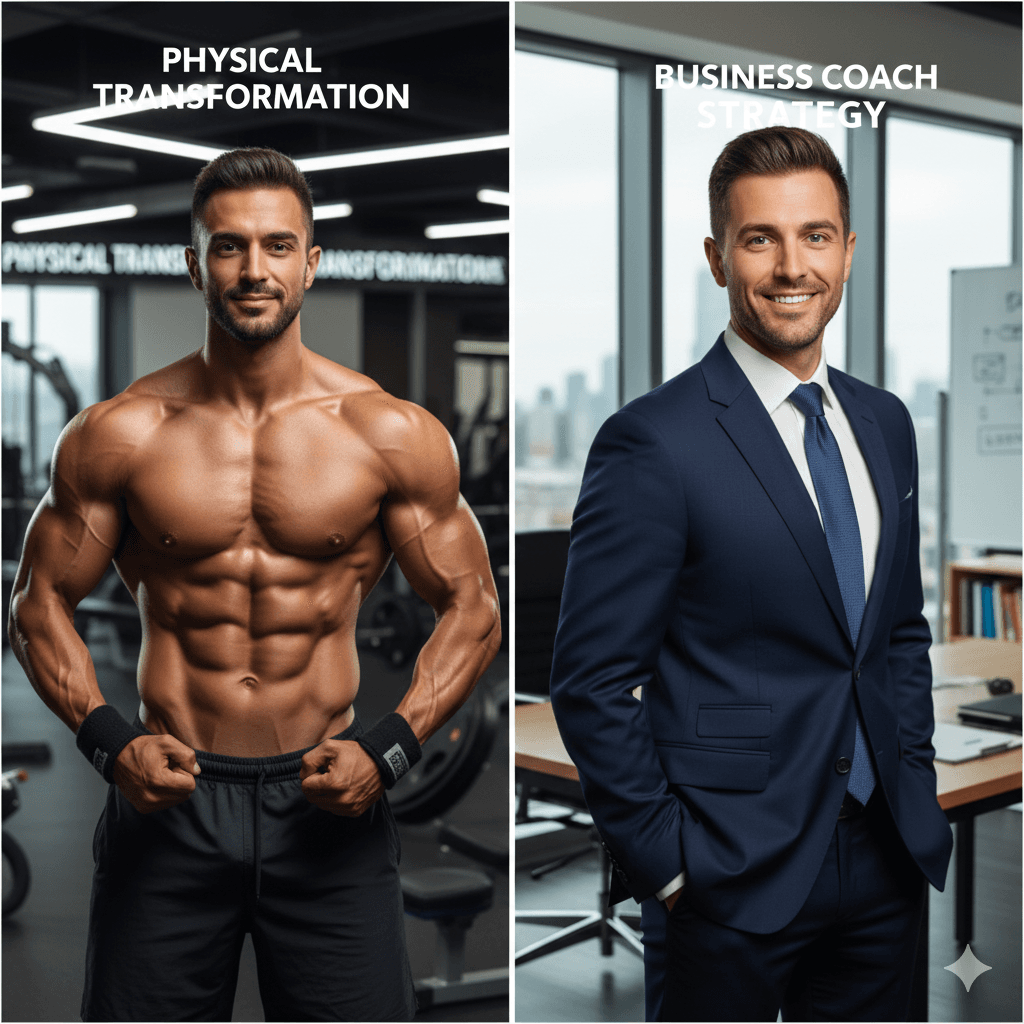

I was scrolling LinkedIn last week when I saw a business strategy coach with his shirt completely unbuttoned, revealing a six-pack that probably cost him 40 hours a week at the gym. His caption was about "optimizing your sales funnel."
Look, I get it. You work hard on your body. That's genuinely impressive. But unless your business is literally about physical transformation, your abs have nothing to do with your expertise in B2B marketing.
Here's the thing that most coaches don't understand: your headshot isn't just a photo. It's a statement about what you're selling and who you're selling it to.
When Showing Your Body Makes You Look Brilliant
Let me be clear upfront – there are coaches where showing physical results isn't just appropriate, it's absolutely necessary.
If you're a fitness coach, your physique IS your portfolio. A personal trainer with visible abs is like a mechanic with clean hands and organized tools – it's visual proof you know what you're doing. Your body is the walking testimonial for your methodology.
Same goes for nutrition coaches, bodybuilding coaches, physique competitors, or anyone whose entire business model revolves around helping people transform their bodies. In these cases, not showing your results would actually be weird. It would be like a hairstylist with terrible hair or a financial advisor driving a beat-up 1992 Honda while preaching wealth building.
I talked to a fitness coach last month who was worried his shirtless gym photos might come across as unprofessional. I told him the opposite – for his business, those photos ARE his credentials. When someone's paying you $200/month to tell them how to build muscle, they want to see that you've actually built muscle yourself.
The difference is context. Your transformation photos belong on your website, your Instagram, your marketing materials. They're evidence. But even fitness coaches need at least one professional headshot for LinkedIn, speaking engagements, and business contexts where you want to be taken seriously as an entrepreneur, not just an athlete.
When Showing Your Body Makes You Look Desperate
Now let's talk about the business coaches, mindset coaches, sales coaches, and marketing consultants who inexplicably feel the need to showcase their abs in professional headshots.
What exactly are you selling here? If I'm hiring you to help me scale my SaaS company, why do I need to know what your torso looks like? Are your pecs going to write my email sequences? Will your biceps optimize my ad spend?
I've noticed this trend especially among male coaches in the 35-50 age range who've pivoted from corporate jobs into coaching. They get in shape, realize they look good, and suddenly every professional photo becomes an opportunity to prove they're still attractive. It reeks of insecurity masquerading as confidence.
The message you're actually sending is: "I don't have enough professional credibility to stand on my expertise alone, so I'm hoping my appearance will distract you from that fact."
And here's what's brutal about it – it works on some people. There's a subset of clients who respond to that aesthetic. But they're usually not the clients who'll stick around long-term or refer you to serious people. You're attracting people who make decisions based on surface-level impressions, which means they'll leave you the moment someone more attractive shows up.
The Thirst Trap Disguised as Authenticity
The excuse I hear most often is: "I'm just being authentic. This is who I am."
No. That's not authenticity. That's exhibitionism with a personal brand wrapper.
Authenticity would be showing up as yourself in appropriate contexts. Nobody's asking you to hide the fact that you work out. Put it in your bio. Share your morning routine. Post gym content on Instagram. But your LinkedIn headshot – the photo that appears next to your business proposals and speaker submissions – doesn't need to feature your abs unless they're directly relevant to your service offering.
I've watched coaches lose corporate contracts because their headshots looked more appropriate for Tinder than for a professional services agreement. The CEO who's considering hiring you to train their executive team isn't impressed by your shredded physique – they're wondering if you understand the difference between personal branding and personal exposure.
There's a reason that most successful professionals understand the difference between personality and exposure. Your personality can absolutely show through in professional photos. But there's a line between "this is authentically me" and "please validate my body."
Industry Standards Exist for a Reason
Every industry has visual norms, and ignoring them doesn't make you a rebel – it makes you look like you don't understand your market.
Finance demands polish. Tech allows casual. Healthcare prioritizes competence over style. As I covered in a previous piece about how different industries have completely different appearance standards, what works in one field bombs in another.
The coaching industry sits in a weird middle ground. It's personal enough that people want to see the real you, but professional enough that they need to trust you with their business or life transformation. Threading that needle requires self-awareness about what your image is actually communicating.
A study from the University of Pennsylvania found that professionals who dress one level above their industry standard are perceived as more competent and trustworthy. The key phrase is "one level above" – not three levels below with your shirt off.
The Real Question: Who Are You Trying to Attract?
This all comes down to client acquisition strategy. Your headshot is marketing, and marketing should be intentional.
If you're a high-ticket B2B coach working with executives and companies, your half-naked beach photo is actively costing you money. Corporate buyers aren't sitting in boardrooms saying, "This leadership consultant looks qualified because I can see his abs through his shirt."
But if you're targeting a younger, wellness-focused audience who values fitness as part of overall life optimization? Then maybe – maybe – strategically incorporating your fitness journey makes sense. Even then, I'd argue you still need one buttoned-up professional option for when the Wall Street Journal wants to interview you about your methodology.
The coaches who succeed long-term are the ones who understand that different contexts require different presentations. You can have your gym content on Instagram and your professional headshot on LinkedIn. These aren't contradictory – they're complementary.
What Actually Builds Credibility
Here's what I've learned from watching thousands of coaches succeed and fail: credentials matter more than aesthetics.
Your headshot should communicate competence, approachability, and expertise in your specific domain. For most coaches, that means:
- Direct eye contact that builds trust
- Professional clothing appropriate to your industry positioning
- Clean background that doesn't distract
- Lighting that makes you look polished but not overly produced
- An expression that matches your brand personality
Notice what's not on that list? Visible muscle definition.
The coaches getting the biggest contracts and speaking at major conferences aren't the ones with the best bodies – they're the ones who look like they understand professional standards while still showing personality.
I've seen business coaches with dad bods book six-figure consulting contracts. I've seen fitness coaches with incredible physiques struggle to break past $3K months because they couldn't figure out how to present themselves in corporate contexts.
The Smart Middle Ground
If you're a coach who's genuinely proud of your fitness results and wants to incorporate that into your brand without looking desperate, here's the move:
Have multiple headshots. One professional option where you look like someone a Fortune 500 company would hire. One more casual option where your personality shines through. Save the transformation photos for your About page or social content where context makes them appropriate.
This isn't about hiding who you are. It's about being strategic with where different aspects of your identity appear. Every element of your visual brand should have a purpose.
Your shirtless beach photo might kill on Instagram and drive engagement from your fitness-focused followers. That same photo on LinkedIn might cost you a $50K corporate training contract because the HR director thought you looked unprofessional.
Know Your Lane
At the end of the day, this isn't complicated. If your business is helping people transform their bodies, show your body. If your business is anything else, your body is probably not your most relevant credential.
The coaches who figure this out early save themselves years of attracting the wrong clients and repelling the right ones. Your headshot is making promises about what you deliver – make sure those promises match what you're actually selling.
And if you're sitting here thinking, "But my abs ARE my personal brand!" – cool. Just know that's a choice, and choices have consequences. You might gain followers. You might lose contracts. That's the trade-off.
The brilliant coaches know exactly what they're doing with every visual element. The desperate ones are just hoping someone notices they're attractive.
Know the difference.