
I respect your service. Genuinely.
But when Marcus Johnson, a former Marine Corps logistics officer, couldn't figure out why he wasn't getting callbacks for supply chain management roles despite his impeccable resume, the answer was staring everyone in the face. Literally. His LinkedIn profile featured him in full dress blues, medals on display, looking every bit the decorated service member he was.
The problem wasn't his qualifications. The problem was that corporate recruiters saw the uniform and made an immediate judgment: "Won't adapt to civilian culture."
It's complete bullshit bias, but it's real. And it's costing veterans jobs they're more than qualified for.
The Uncomfortable Truth About Civilian Hiring Bias
Let me be direct about something that makes a lot of people uncomfortable: hiring managers have preconceived notions about military veterans, and your uniform photo is triggering every single one of them.
They see "rigid thinking" when they should see discipline. They see "difficulty with authority" when they should see leadership. They see "can't work in ambiguous environments" when they should see someone who operated under actual life-or-death pressure.
I've watched this play out hundreds of times in customer conversations. Veterans with stellar service records and directly transferable skills getting passed over for 24-year-olds with marketing degrees and zero management experience. The only difference? The 24-year-old had a standard corporate headshot, and the veteran had a photo in uniform.
A veteran who spent eight years managing multi-million dollar equipment inventories shouldn't be losing supply chain jobs to someone whose biggest accomplishment was organizing a campus fundraiser. But that's exactly what happens when your LinkedIn photo screams "military" and the hiring manager's mental model of "good culture fit" is someone in business casual holding a latte.
Why Your Uniform Photo Is Working Against You
Your military service is probably the most impressive thing on your resume. The leadership experience, operational excellence, working under pressure – these are exactly what civilian employers claim they want.
So why hide it in a civilian headshot? You're not hiding it. You're translating it.
Think about it this way: when you brief a civilian stakeholder on a military operation, you don't use military jargon and acronyms. You translate the information into language they understand. Your headshot needs to do the same thing.
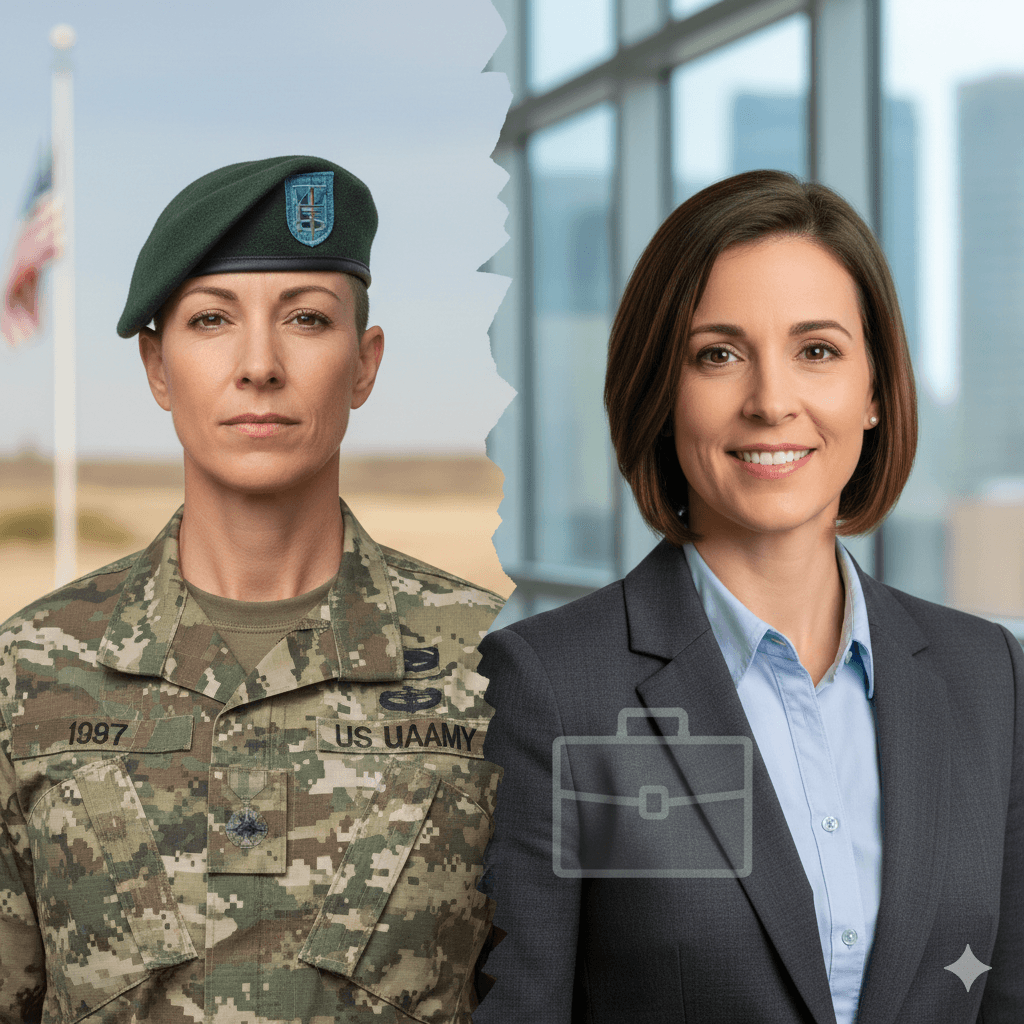
The uniform photo says "I'm from a different world than you." The civilian professional photo says "I can operate in your world while bringing unique expertise."
Sarah Martinez, an Air Force veteran who spent six years in cybersecurity operations, ran into this exact problem. Her LinkedIn profile featured her in service dress, and despite having security clearances and hands-on experience that most civilian candidates couldn't match, she kept getting the same feedback: "We're looking for someone with more corporate experience."
Translation: "We're not sure you'll fit in here."
After switching to a standard professional headshot in business attire, Sarah started getting different responses. Same resume, same skills, same professional summary. The only change was the photo. Suddenly recruiters wanted to "learn more about her unique background" instead of questioning her "fit."
The skills didn't change. The perception did.
The Psychology Behind the Bias
There's actual research on this. A Duke University study published in 2024 examined how hiring managers evaluated veterans' resumes. The researchers found that managers consistently rated veterans as better suited for "back-office" roles rather than positions requiring interpersonal skills – even when the veterans' qualifications were identical to non-veteran candidates.
"This bias was occurring among actual managers who are in the business of hiring people," said Aaron Kay, the study's senior author. "As these managers were evaluating applicants' resumes, their choices showed they thought veterans were more suited to the kitchen as opposed to jobs where they would be dealing with people."
When a recruiter spends 6 seconds scanning your resume – and that's literally all the time most applications get – you don't want half of that time spent on them processing "military person" and running through their mental checklist of stereotypes.
You want them processing "qualified professional with relevant experience."
This isn't about hiding your service. Your resume makes your military background crystal clear. Your experience section details your accomplishments. Your recommendations probably reference your leadership in uniform. That context is all there.
The headshot just needs to say "I'm ready for this civilian role" instead of "I'm still in my previous world."
The Veteran Double Standard Nobody Talks About
Here's what really pisses me off about this whole situation: corporate recruiters will wax poetic about "leadership experience" and "working under pressure" and "mission-driven candidates." Then a veteran shows up with actual, documented experience in all of those areas, and suddenly there are "culture fit concerns."
A 28-year-old veteran who led a team of 15 people in a combat zone has infinitely more leadership experience than a 32-year-old middle manager who runs Zoom meetings about Q3 projections. But the middle manager gets the promotion, and the veteran gets told they "need to prove themselves in a corporate environment first."
The uniform photo just gives recruiters an easy excuse to act on their preexisting bias. Remove the excuse, and they have to actually evaluate your qualifications.
I've seen veterans with project management experience that would make most PMPs jealous get rejected for entry-level coordinator roles because the hiring manager "wasn't sure they could handle the collaborative nature of the role." Meanwhile, the person who got hired had never managed anything more complex than their own calendar.
The bias exists whether you wear the uniform in your photo or not. But at least without the uniform, recruiters have to pretend to evaluate you fairly.
What Actually Works for Veteran Headshots
After seeing hundreds of veterans successfully transition to civilian careers, here's what actually moves the needle:
Standard business attire for your target industry. If you're going into finance, wear what finance people wear. Tech? Business casual. Sales? Sharp but approachable. You're not pretending to be something you're not – you're showing you understand the visual language of your new industry.
Neutral, professional background. Not an office setting that screams "I staged this," but also not anywhere that reads as distinctly military. Clean, simple, forgettable background that puts all the focus on you.
Approachable expression. The "military bearing" photo where you look like you're about to inspect someone's uniform? That's great for command photos. Terrible for LinkedIn. You want to look confident but friendly. Competent but collaborative.
Current civilian look. If you're still rocking the high-and-tight haircut or clean-shaven look from your service, consider updating. Not because there's anything wrong with either – but because you want to signal "I've made the transition" visually as well as professionally.
Look, I get the pride aspect. You earned those medals. You served honorably. That uniform represents years of sacrifice and achievement. Putting it in your professional headshot isn't bragging – it's acknowledging something genuinely impressive.
But the job market doesn't care about fair. It cares about perception. And if your uniform photo is costing you interviews, the principle isn't worth the price.
The Transition Process Most Veterans Miss
The biggest mistake I see veterans make is thinking the transition from military to civilian work is purely about translating job titles and responsibilities. "Logistics officer becomes supply chain manager." "Intelligence analyst becomes business analyst." The resume keyword optimization part.
They nail the resume. They nail the cover letter. They even nail the interview prep.
Then they tank the whole thing with a profile photo that makes recruiters mentally file them under "military person trying to break into corporate" instead of "qualified candidate who happens to have military experience."
Your visual presentation is part of the translation process. When you remove military jargon from your resume, you're making your experience accessible to civilian readers. When you remove the uniform from your headshot, you're doing the same thing visually.
This connects to something I've written about before regarding how your 55-year-old boss judges your headshot harder than your work. The decision-makers evaluating your resume are often older, more traditional, and operating from outdated mental models about what "professional" looks like. Fair? No. Reality? Yes.
When Keeping the Uniform Makes Sense
There are exactly three scenarios where your uniform photo is the right call:
You're applying to defense contractors. If you're targeting Lockheed Martin, Northrop Grumman, or similar companies, your military background is your primary selling point. The uniform signals relevant experience.
You're pursuing a government role. Federal agencies and government contractors understand military culture. The uniform isn't a liability there.
You're building a veteran-focused business. If you're a consultant working specifically with veteran-owned businesses or military transition coaching, the uniform establishes immediate credibility with your target market.
For literally everything else? Civilian headshot. No exceptions.
The Technical Execution
Getting the right photo isn't complicated, but veterans overthink it. You don't need a $500 photographer session. You need a clean, current photo that looks like you belong in a civilian office.
If you're on a tight budget – and I know the transition period can be financially rough – a smartphone and decent lighting will get you 80% there. Find a friend with an eye for composition, put on your interview outfit, and take 50 shots. Pick the best three, post them to a veterans' Facebook group, and ask which one reads most "corporate."
Or if you want something more polished without the scheduling hassle of traditional photography, there are AI headshot services that can generate professional photos from regular selfies. Upload a few casual photos, get back professional headshots in civilian attire. The technology's gotten good enough that nobody can tell the difference, and it costs less than what you'd spend on gas driving to a photography studio.
The point isn't perfection. The point is removing the visual barrier between your qualifications and the hiring manager's perception.
The Bigger Picture on Veteran Employment
This whole conversation shouldn't be necessary. Companies should evaluate veterans based on their actual capabilities, not make snap judgments based on a profile photo. Hiring managers should recognize that someone who planned logistics for a military operation can probably handle corporate supply chain management.
But we don't live in that world. We live in a world where your LinkedIn photo gets 0.5 seconds of attention, and if it triggers the wrong associations, your resume never gets read.
I've built a business around helping professionals optimize their visual presentation, and the veteran transition issue comes up constantly. It's one of the few cases where the fix is obvious, the execution is simple, and the impact is immediate – yet people resist because of principle.
I respect the principle. But I respect your rent getting paid more.
Your service matters. Your experience is valuable. Your qualifications are probably stronger than 90% of the civilians you're competing against. Don't let a uniform photo be the reason someone never finds that out.
Get a civilian professional headshot. Update your LinkedIn. Let your actual experience speak for itself without the visual distraction of military service dress.
You earned the right to wear that uniform. You also earned the right to a civilian career that fully values your capabilities. Sometimes getting the second one means putting away the first one – at least in your LinkedIn profile photo.
The Bottom Line
Corporate America has a veteran employment problem, and it's largely a perception problem masquerading as a "culture fit" concern. Your uniform photo feeds directly into that perception problem.
Switching to a civilian headshot doesn't erase your military experience. It doesn't diminish your service. It doesn't mean you're ashamed of your background. It means you understand how hiring decisions actually get made, and you're not going to let stupid stereotypes cost you the job you're qualified for.
Every day you spend with a uniform photo on LinkedIn is another day of potential opportunities passing you by because a recruiter made a snap judgment in the first three seconds of viewing your profile.
The military taught you to accomplish the mission with the resources available. Right now, the mission is getting hired in a civilian role. The resource available is understanding how civilian hiring actually works, not how it should work.
Use it.
Your service got you to this point. Your headshot shouldn't be what stops you from moving forward.