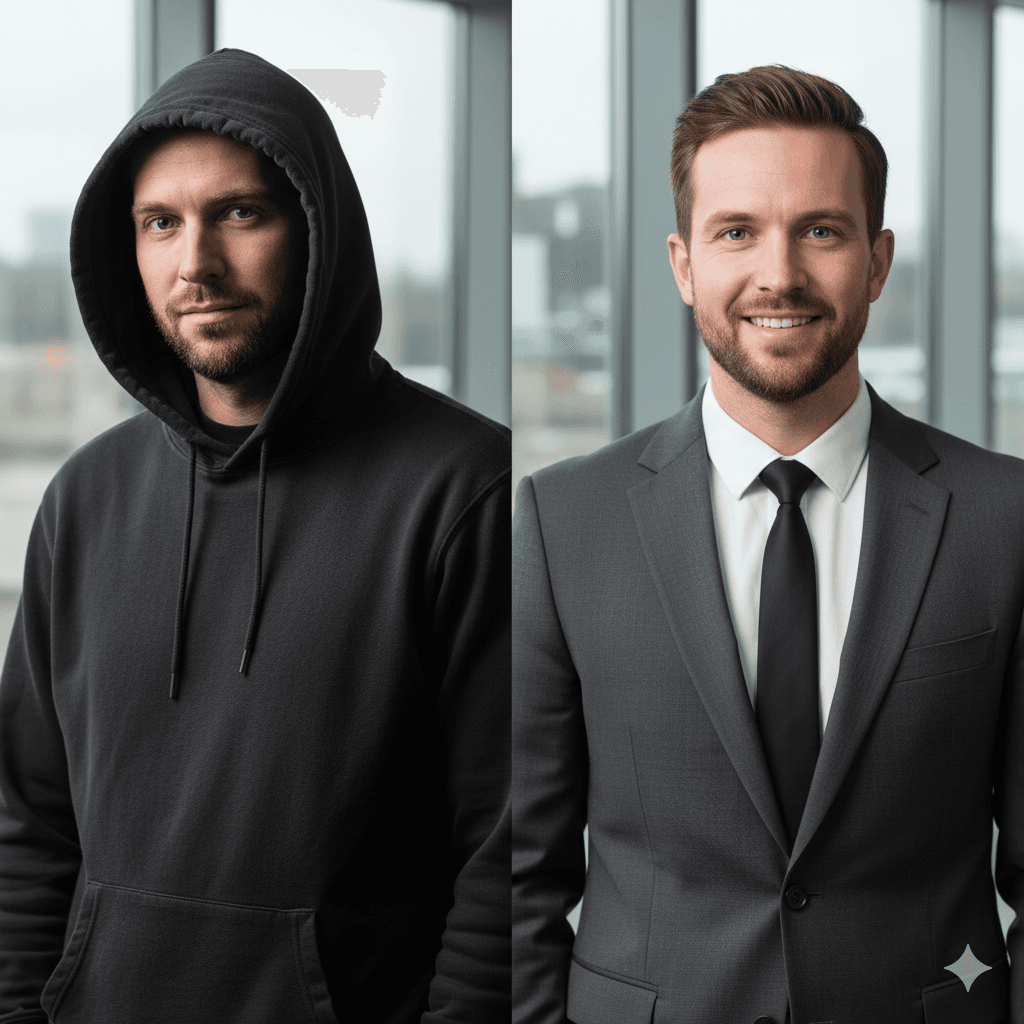

I saw a LinkedIn profile yesterday that perfectly captured what's wrong with professional branding in 2025. The guy was a talented product manager with seven years of experience at solid companies. His headline read "Disrupting traditional workplace culture." His headshot? A gray hoodie, messy hair, arms crossed, staring at the camera like he was about to drop a diss track.
His last post was from three months ago asking if anyone was hiring.
Here's the thing nobody wants to tell you: unless you're Mark Zuckerberg or have already built a billion-dollar company, your hoodie headshot doesn't make you look authentic. It makes you look unemployed.
The "Authentic Self" Delusion
Somewhere along the way, a bunch of LinkedIn influencers convinced an entire generation that "being yourself" meant rejecting basic professional standards. They told you that showing up in a hoodie was brave, that ditching the suit was revolutionary, that professionalism was just gatekeeping.
And you believed them because it felt good. It felt rebellious. It felt like you were sticking it to corporate America and their stuffy dress codes.
Meanwhile, the hiring manager reviewing your application is 58 years old, runs a department with a $50 million budget, and thinks hoodies mean one of three things: you're lazy, you're immature, or you don't take this seriously.
That LinkedIn influencer who told you to "be authentic"? They already made their money. They built their brand when professional standards still mattered, then pivoted to selling rebellion once they had nothing left to lose. You're taking career advice from people playing a completely different game than you are.
What Your Hoodie Actually Signals
Let me break down what decision-makers actually see when they look at your casual headshot:
"I don't understand context." Professional photos aren't about you. They're about making the person looking at you feel comfortable choosing you. When you show up in a hoodie, you're signaling that you either don't understand this or don't care. Either way, it's not good.
"I'm not willing to adapt." Every industry has visual language. Finance speaks in navy suits and clean lines. Tech allows more flexibility, but there's still a baseline. When your photo ignores these standards entirely, you're broadcasting that you'll probably ignore other professional norms too.
"I value my comfort over your perception." And look, I get it. You should be comfortable. But your headshot isn't for you – it's for the people who need to trust you with important work. That trust starts with showing you understand professional context.
There's actual research backing this up. A study published in the Journal of Applied Psychology found that candidates whose appearance matched industry norms received significantly higher competence ratings, even when qualifications were identical. Your hoodie isn't expressing individuality – it's actively working against your career goals.
The Zuckerberg Exception Doesn't Apply to You
"But Mark Zuckerberg wears hoodies!" Yeah, and Mark Zuckerberg built Facebook first. Steve Jobs wore black turtlenecks after creating Apple. Richard Branson rocks casual island shirts because he founded Virgin.
You notice a pattern? They earned the right to ignore convention by first mastering it and then building something so valuable that nobody could afford to dismiss them.
You haven't built Facebook. You're not revolutionizing an industry. You're applying for jobs and hoping someone will take a chance on you. The rules are different, and pretending they're not is just self-sabotage with extra steps.
When you're the one making hiring decisions for your own company, wear whatever you want. Until then, play the game that's actually being played, not the one you wish existed.
Different Industries, Different Rules
I've talked to enough professionals across industries to know there's nuance here. A software engineer at a startup can absolutely get away with more casual photos than a corporate lawyer. A creative director has more flexibility than a financial analyst. Context matters.
But here's what doesn't change: even in the most casual industries, there's a difference between "relaxed professional" and "I just rolled out of bed." The hoodie sits firmly in the latter category for most decision-makers.
I wrote before about how different industries have wildly different appearance standards. Tech might let you get away with a t-shirt, but it should still look intentional. Finance demands traditional polish. Healthcare cares more about competence signals than fashion.
What matters is understanding where your industry sits on that spectrum and dressing your photos accordingly. "Authentic" doesn't mean ignoring context – it means showing the best, most professional version of yourself within that context.
The Age Gap Nobody Talks About
Here's the uncomfortable truth: the people hiring you are probably 20-30 years older than you. And whether you think it's fair or not, they judge professionalism differently than your peers do.
I covered this in detail when I wrote about how your 55-year-old boss judges your headshot harder than your work. That hiring manager who thinks your hoodie signals laziness? They're not wrong by the standards they were raised with. They're not being unfair – they're applying the professional norms that got them where they are.
You can argue all day about whether those norms should exist. You can write passionate LinkedIn posts about how outdated professional dress codes are. But while you're making your principled stand, someone else in a proper headshot is getting the interview you wanted.
Is that fair? Probably not. Is that reality? Absolutely.
What "Professional" Actually Looks Like Now
Professional photos in 2025 don't mean suit and tie for everyone. But they do mean looking intentional, put-together, and like you understand context.
For most industries, that means:
- A collared shirt at minimum (doesn't have to be formal, just structured)
- Good lighting that doesn't make you look like you're hiding in your basement
- A neutral or appropriate background
- Eye contact with the camera
- Looking like someone who takes their career seriously
None of this requires a professional photographer or expensive clothes. You just need to look like you tried. The bar is surprisingly low – you'd be amazed how many people can't even clear it.
When Casual Actually Works
There are exactly three scenarios where a more casual headshot doesn't hurt you:
You're already so qualified that nobody cares. Senior engineer at Google with 15 years of experience? Sure, wear the hoodie. Your resume does the talking. Entry-level candidate with three years of experience? Different story.
You're in a genuinely casual industry. Early-stage startup founder in a beach town? Game developer? Maybe the hoodie works. But even then, it should look intentional, not accidental.
You've already built a personal brand that makes it work. If you've established yourself as an expert in your field and your casual photo fits that brand, go for it. But that takes years to build.
For everyone else – which is most people – the casual headshot is just making your job search harder for no good reason.
The Cost of Being "Authentic"
Let's talk real numbers. That product manager I mentioned at the beginning? He told me he'd been job searching for five months. Qualified for the roles. Got past the initial screening. Made it to second or third round interviews. But kept losing out to other candidates.
Was it definitely his hoodie photo? Impossible to prove. But here's what I know: first impressions happen in milliseconds. Research shows people make judgments about competence and trustworthiness in about 100 milliseconds of seeing a face. When you're competing against candidates with similar qualifications, anything that creates doubt – even subconsciously – can be the difference between an offer and rejection.
He finally updated his LinkedIn photo to something more professional. Three weeks later, he had two offers. Coincidence? Maybe. But I've seen this pattern enough times to know it's not random.
Your authentic self isn't just costing you opportunities – it's costing you real money. That $150k job you didn't get because you wanted to make a point about dress codes? That's not brave. That's expensive.
How to Actually Stand Out
Want to know what actually makes you stand out in a sea of professional headshots? Being memorable for the right reasons while still looking professional.
Good lighting that makes you look alive instead of half-dead. A background that's interesting without being distracting. Actual eye contact with the camera instead of that side-angle thing everyone does. Looking like a real person instead of a corporate stock photo – but still looking put-together.
AI headshot tools have actually gotten good at this. They can take your regular photos and create professional versions that still look like you, just cleaned up and appropriate for whatever industry you're in. No photographer needed, no awkward posing, just professional photos that don't torpedo your career prospects.
The goal isn't to create some fake version of yourself. It's to present yourself in a way that doesn't immediately disqualify you from opportunities you're actually qualified for.
Save the Rebellion for After You Get the Job
Once you're in? Once you've proven yourself and built relationships and established trust? Then you can push boundaries. Then you can show up however you want because people judge you on your work, not your appearance.
But until then, your headshot is not the place to make a political statement about authenticity. Your LinkedIn profile is not the battlefield where you fight against professional norms. Those fights might feel good, but they're costing you money and opportunities.
The professionals who actually succeed aren't the ones who reject all standards – they're the ones who understand when to follow them and when they've earned enough credibility to break them.
Your hoodie headshot isn't revolutionary. It's not authentic. It's not brave. It's just making your career harder than it needs to be, and the only person paying that price is you.
Wear whatever you want in your actual life. But for the photo that represents you to hiring managers, investors, clients, and anyone else who controls your opportunities? Look the part. You can be authentic after you cash the check.