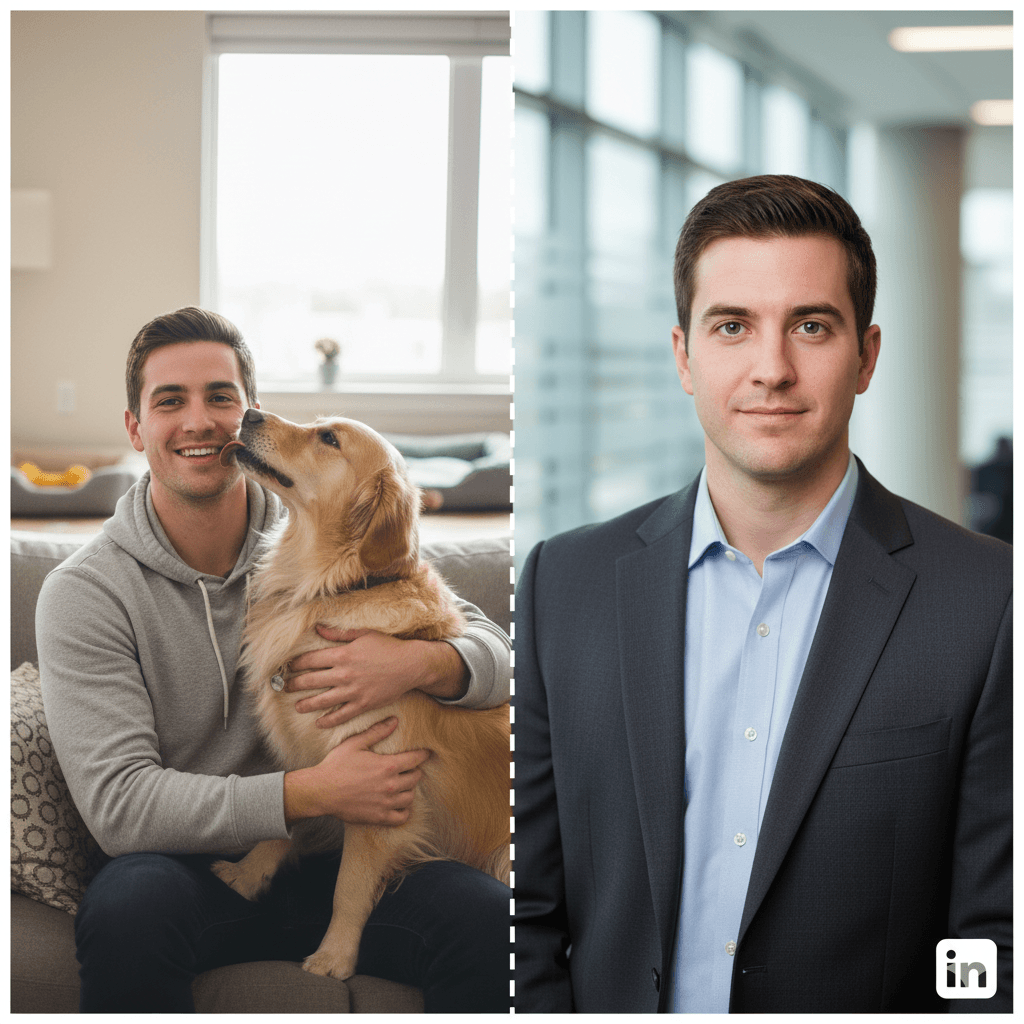

Three weeks ago, I was scrolling through LinkedIn connection requests when I came across Rachel. Senior Product Manager at a tech startup. Eight years of experience. Impressive resume. Profile photo? Her sitting on a porch with a massive golden retriever taking up half the frame.
I accepted the connection, but I'll be honest – that photo made me pause. Not because I hate dogs, but because it made me wonder if she understood professional context. When you're trying to make a strong first impression, your profile photo shouldn't make people second-guess whether you're serious about your career.
Here's the thing nobody wants to say out loud: your dog doesn't belong in your professional headshot. I don't care how cute Bailey is. I don't care that he's "part of your life." Your weekend hobbies don't belong on your business profile either, and nobody's putting their PlayStation controller in their LinkedIn photo.
"But My Dog Is Part of My Brand!"
No, it isn't. Unless you're a veterinarian, dog trainer, or pet product entrepreneur, your dog is completely irrelevant to your professional value proposition.
I see this excuse constantly, especially from consultants and coaches who think including their dog makes them "relatable" or "authentic." What it actually makes you is someone who fundamentally misunderstands what LinkedIn is for.
LinkedIn is not Instagram. It's not Facebook. It's a professional networking platform where people evaluate whether they want to hire you, work with you, or do business with you. And recruiters want to hire YOU, not your golden retriever.
When I talk to hiring managers about what affects their perception of candidates, pet photos come up surprisingly often. "It doesn't necessarily disqualify someone," one VP of Engineering told me. "But it does make me wonder about their judgment. It's just... not what you expect to see on a professional profile."
Another recruiter put it this way: "For junior roles, I barely notice. But when I'm hiring for senior positions and someone's LinkedIn photo includes their dog, it creates this disconnect. They might be incredibly qualified, but the photo makes them look less polished than their competitors."
The Psychology Behind Why This Backfires
The issue comes down to context confusion. LinkedIn operates on professional norms, and mixing personal elements into professional spaces sends mixed signals. When someone sees your profile photo, they're making instant judgments about your professional credibility – and a dog in the frame creates cognitive dissonance.
It's the same reason you don't bring your dog to a job interview, even though it would definitely lighten the mood. Professional contexts have different rules than personal ones, and confusing the two signals poor judgment.
Think about it from a hiring manager's perspective. They're reviewing 50 LinkedIn profiles for a senior role. Forty-nine people have clean, professional headshots. One person has their dog in the frame. That person might not get automatically rejected, but they do start at a slight disadvantage. The photo becomes a distraction rather than an asset.
When Your "Authentic" Brand Becomes a Liability
The authenticity argument drives me insane. Yes, being genuine matters. But "authentic" doesn't mean dragging every aspect of your personal life into professional spaces.
I'm authentic with my friends when I complain about bad dates or share memes about existential dread. I'm authentic with my therapist when I talk about childhood issues. I'm authentic at work when I admit I don't know something or made a mistake. But those are different versions of authenticity for different contexts.
Your professional brand should reflect the parts of you that are relevant to your work. If you're a marketing director, your brand might include your strategic thinking, your track record of campaign results, your industry insights. It probably doesn't include your dog, your weekend hiking trips, or your sourdough bread obsession – unless you're marketing pet products, outdoor gear, or bakeries.
Mike learned this through experience. He's a financial advisor who kept his profile photo with his husky for two years because "people connect with pet owners." His results were decent, but not great. When he finally updated to a solo headshot, he noticed his connection acceptance rate improve gradually over the next few months. "I don't think the dog photo was killing my business," he told me. "But the professional headshot definitely opened more doors. People seemed to take me more seriously right from the first interaction."
The Exceptions That Prove the Rule
There are exactly three scenarios where a dog in your professional photo makes sense:
You're a veterinarian. Obviously. Your patients are animals. Including them shows you're comfortable with what you do.
You're a dog trainer or pet industry professional. If your entire business revolves around dogs, then yes, demonstrate that in your visual presence. A dog trainer without dogs in their branding would be weird.
You run a pet product company. If you're the founder of a dog food startup or pet tech company, your product IS dogs. Include them.
For literally everyone else? No. Your dog is not a professional credential.
What Recruiters Actually See
I asked a dozen recruiters what goes through their minds when they see pet photos in professional profiles. The responses varied but had common themes:
"It doesn't bother me for entry-level roles, but for senior positions it feels off. I expect more polish at that level."
"I don't automatically reject them, but it does make me pay closer attention to whether the rest of their profile is professional."
"Honestly, it just seems like a missed opportunity. Why use your one profile photo on something that distracts from your qualifications?"
"For creative roles, it might work. But for corporate positions, it raises questions about cultural fit."
The pattern is clear: it's not a dealbreaker, but it's not helping you either. At best, it's neutral. At worst, it's creating unnecessary doubt in people's minds.
The last point is worth emphasizing. The more senior you get, the more people expect polished professional presentation. A 24-year-old junior analyst with a dog photo gets a pass because everyone knows they're still learning professional norms. A 45-year-old VP with a dog in their headshot creates cognitive dissonance – the experience level and the photo don't match.
The Facebook vs. LinkedIn Test
Here's a simple rule: if you wouldn't bring it to a client meeting, it doesn't belong in your professional headshot.
Would you bring your dog to a pitch meeting with a potential client? No? Then it doesn't belong in your LinkedIn photo.
Would you bring your kids to a job interview? No? Then they don't belong in your professional headshot either, which is a whole separate problem.
Facebook is for your personal life. That's where Bailey gets to shine. That's where you can share cute photos of your morning walks and weekend adventures. LinkedIn is for your professional life. Keep them separate.
How This Actually Affects Your Career
The impact is subtle and hard to measure. You probably won't get rejected specifically because of your dog photo – hiring decisions are more complex than that. But you might get overlooked in favor of someone whose profile presents a more polished first impression. The recruiter might spend an extra second on the next profile. The potential client might feel a slightly stronger connection with someone else's more professional presentation.
These tiny moments compound over time. You don't realize the photo is costing you anything because the opportunities just quietly go to other people. Nobody sends you an email saying, "Great qualifications, but the golden retriever was a concern." They just move on to the next candidate.
Sarah ran a coaching business for three years with moderate success. Her LinkedIn photo featured her and her chocolate lab on a hiking trail. "I loved that photo," she told me. "It felt authentic." When she updated to a clean professional headshot, her consultation booking rate improved gradually over six months. "I can't prove it was just the photo, but something shifted. People seemed to take me more seriously from the initial contact."
The "Relatable" Trap
A lot of professionals include dogs because they think it makes them more relatable or human. This backfires for two reasons:
First, it makes you relatable to dog people and alienating to everyone else. Cat people, people with pet allergies, people who just aren't into animals – they all look at your profile and immediately know you're not their kind of person. You've accidentally filtered out a huge portion of potential connections over something completely irrelevant to your work.
Second, you don't need a dog to be relatable. You know what's actually relatable? Being good at your job. Having interesting professional insights. Showing genuine expertise. Those are the things that make people want to connect with you professionally.
If your personality doesn't come through in your work, your writing, your professional presence – then adding a dog photo isn't going to fix that. It's just going to distract from whatever value you actually bring.
What to Do Instead
Get a proper professional headshot. Just you. Clear background. Good lighting. Professional attire appropriate for your industry. It's not complicated, and it doesn't require abandoning your personality.
Want people to know you love dogs? Put it in your "About" section. Mention volunteering at animal shelters. Share posts about pet adoption. There are dozens of ways to express that part of yourself without compromising your professional image.
The most successful professionals I know have spotless, polished LinkedIn profiles with zero personal elements in their headshots. Then if you meet them in person or follow them on Instagram, you discover they're into rock climbing or have three rescue cats or collect vintage motorcycles. But they understand the difference between personal interests and professional presentation.
Your LinkedIn headshot has one job: make people take you seriously as a professional. That's it. Not make them think you're fun at parties. Not show them you're a dog person. Just establish that you understand professional standards and know how to present yourself appropriately.
Bailey will understand. He's a good boy, and he doesn't need to be in your LinkedIn photo to prove it.
The Bottom Line
Look, I'm not saying your dog photo will destroy your career. Plenty of people have successful careers with less-than-perfect LinkedIn photos. But why start with an unnecessary disadvantage?
The people with the strongest professional presence tend to have clean, focused headshots. The ones who treat LinkedIn more casually often wonder why their engagement isn't better or why certain opportunities don't materialize. The connection might not be obvious, but it's there.
You can keep your dog photo if it's important to you. But understand that in professional contexts, perception matters. Every element of your profile either reinforces or undermines how seriously people take you. Your headshot is your first impression – make it count.
Get a proper professional headshot. Put Bailey on your Instagram where he belongs. And see if your professional interactions improve when your profile looks like it belongs on LinkedIn, not Facebook.
Your dog is adorable. Your professional profile should be professional.